Precise application
The brush helps apply a controlled layer to affected skin, toe areas and around affected nails.
Fungacillin-P incorporates advanced treatment and application technology for foot and nail fungus infections, including onychomycosis and athlete’s foot (tinea pedis).
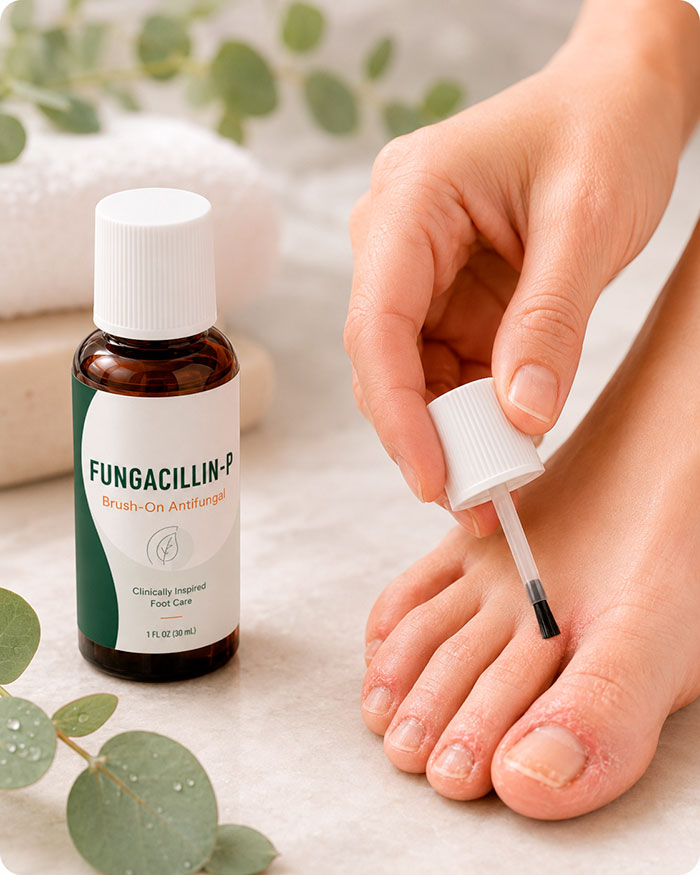
Watch how Fungacillin-P combines targeted application with a simple daily routine for athlete’s foot, fungal skin around the toes and affected nail areas.
Undecylenic acid, one of the ingredients in Fungacillin-P, is an over-the-counter antifungal fatty acid used to help inhibit fungal growth on accessible skin surfaces. Because topical products may have difficulty reaching infection located beneath a thickened nail plate, consistent application and the gradual growth of a new, healthier-looking nail are important parts of the care process.
Fungacillin-P was developed to combine established topical antifungal care with selected supportive ingredients and a precision brush-on delivery format. Its formulation concept focuses on improving contact with affected areas, supporting penetration across the nail surface and addressing the protective environment associated with fungal biofilms.
The formulation is based on years of research into selected polyphenols and other supportive compounds studied for antifungal, antioxidant and biofilm-related properties. Together, these components are intended to provide a practical triple-action approach: topical antifungal activity, biofilm-focused support and improved contact with the affected nail and surrounding skin.
Because over-the-counter topical products generally work from the surface, visible improvement in a fungal toenail can take several months while damaged nail tissue grows out. Fungacillin-P is designed to make this long-term routine easier to apply and maintain.
A practical brush-on topical antifungal format for athlete’s foot, fungal skin around the toes and affected nail areas.
The brush helps apply a controlled layer to affected skin, toe areas and around affected nails.
No complicated preparation. Clean, dry and apply according to the product directions.
Works best alongside breathable shoes, dry socks, clean feet and disinfected nail tools.
Fungacillin-P was created for people who want an antifungal routine that feels simple, direct and manageable.
Follow the final label directions and warnings. Use only as directed.
Wash the affected foot and surrounding skin before application.
Pay special attention between toes, where retained moisture can encourage fungal growth.
Apply a thin layer to affected skin and the surrounding area according to the label.
Foot fungus can return when damp footwear, shared surfaces or contaminated tools remain part of the routine.
Fungacillin-P combines an established topical antifungal ingredient, a plant-derived polyphenol complex and a precision brush-on delivery format.
Undecylenic acid is an over-the-counter fatty acid used to help inhibit fungal growth in certain superficial fungal skin infections.
Plant-derived polyphenols are studied for antifungal, antioxidant and biofilm-disrupting activity against several fungal species.
The brush-on format places the solution directly on affected skin, around the toes and along the visible edges of affected nails.
Both nail fungus and athlete's foot are commonly associated with dermatophytes and other fungi. Infection may spread from the skin to the nail or from an infected nail back to surrounding skin.
Fungal toenails may become brittle, discolored, thickened or painful. They are more common in older adults and can spread through contaminated surfaces, footwear and nail-care tools.
Athlete's foot commonly affects the skin between the toes and on the soles of the feet. Symptoms can include itching, redness, scaling, cracking and burning.
Use Fungacillin-P consistently as part of your daily foot-care routine and follow the directions provided with the product.
Undecylenic acid is used in non-prescription topical antifungal products for certain superficial fungal skin infections.
At higher over-the-counter strengths, often up to 25% depending on the product and jurisdiction, undecylenic acid is used to help stop fungal growth on accessible skin surfaces. It works best when applied consistently to clean, dry skin according to label directions.
Topical products can have difficulty reaching deeply beneath a thickened nail plate. For this reason, skin surrounding the nail is generally more accessible than infection located deep within the nail bed. Visible nail restoration may take months because a new, healthy nail must grow forward gradually.
Light filing of a thickened nail surface is sometimes used in nail-care routines, but this should only be done when appropriate and without causing injury. People with diabetes, poor circulation or reduced sensation should seek professional advice before filing or treating nails at home.
Polyphenols are naturally occurring plant compounds investigated for antimicrobial, antioxidant and antifungal properties.
Some polyphenols may alter fungal cell membranes, surface charge and hydrophobicity, affecting membrane stability and function.
Research suggests certain polyphenols can interfere with fungal biofilm formation, which may reduce the organism's protective environment.
Some polyphenols may promote reactive oxygen species inside fungal cells, contributing to cellular stress and impaired growth.
Certain polyphenols are studied for effects on ergosterol-related pathways, an important component of fungal cell membranes.
Polyphenols may interfere with fungal enzymes involved in metabolism, replication and cell maintenance.
Laboratory studies have explored whether selected polyphenols can enhance the activity of conventional antifungal agents.
Polyphenols can be degraded during normal digestion when consumed orally. Topical delivery avoids the digestive process and places the formulation directly on the skin. Modern delivery systems are studied for their ability to improve solubility, stability, controlled release, skin adhesion, hydration, retention and penetration.
This combination of targeted topical delivery and plant-derived compounds is designed to support a practical, consistent antifungal foot-care routine.
Scientific literature highlights several plant-derived compounds with potential antifungal properties.
A turmeric-derived polyphenol studied against Candida and other fungal organisms.
A green-tea catechin investigated for effects on fungal cell walls and Candida biofilms.
A grape-derived stilbene studied for effects on mycelial growth and fungal spore germination.
A plant polyphenol studied against several fungal species, including resistant Candida strains.
A flavonoid found in many fruits and vegetables and investigated for antifungal activity.
Phenolic acids studied for their ability to restrict the growth of various fungal organisms.
Polyphenols used in research and formulation development may be obtained from a range of plant-derived sources.
Rich in catechins such as EGCG and other phenolic compounds.
Contains punicalagins, gallic acid and ellagic acid.
A source of proanthocyanidins and related polyphenols.
A resinous bee product containing flavonoids and other bioactive compounds.
Commonly associated with grapes, berries and selected botanical extracts.
Found in coffee, green tea and numerous plant materials.
A concentrated source of curcuminoids, including curcumin.
Potential sources of quercetin, caffeic acid and gallic acid derivatives.
Each Fungacillin-P package includes a 30 mL bottle with a brush-on applicator and complete, simple instructions.
Approximately one month of topical antifungal care for one person.
It is presented as a topical antifungal product for athlete’s foot and fungal skin around the toes and affected nail areas. Use the product according to the directions provided.
Yes. Fungal infection may affect both skin and toenails. Nail infections are often harder to treat because they may extend beneath the nail plate.
Use the product for the period stated on the label. Skin symptoms may improve before a damaged toenail looks normal because toenails grow slowly.
Seek medical advice for diabetes, poor circulation, immune suppression, severe pain, swelling, drainage, spreading redness, uncertain diagnosis or symptoms that do not improve.
Fungi can persist in warm, moist environments. Topical treatment generally requires regular application for the full label-directed period, even when symptoms begin to improve.
The infection may be protected beneath a thick nail plate, and toenails grow slowly. The damaged nail must gradually be replaced by new growth.
Polyphenols are included for their researched antifungal, antioxidant and biofilm-related properties. Specific product benefits must be supported by the final formula and product-specific evidence.
Keep feet dry, wear moisture-wicking socks, rotate and dry footwear, use sandals in communal areas, disinfect nail tools and address athlete's foot promptly.
Order a 30 mL brush-on bottle for $39 per person. Complete instructions are included.

